We've recently updated our Terms of Service and Privacy Policy.

At some point after starting SEO, almost every business owner has the same thought: How long is this supposed to take? You are publishing content, making updates, maybe even hearing that things are “moving in the right direction,” but it is not always obvious what that means. SEO is a long-term strategy, but that does not mean you should be guessing. There are real milestones you can expect along the way.
There is no single timeline that applies to every business. SEO does not work like paid ads where results appear immediately. It builds momentum as your website earns visibility and trust over time. While this takes patience, it is not guesswork. Well-executed SEO follows a fairly consistent pattern.
Let’s walk through what typically happens, when it happens, and how to tell if things are moving in the right direction.
SEO works by helping search engines trust your website. That trust is based on signals like how useful your content is, how closely it matches what people are searching for, how established your site appears compared to others in your space, and how consistently you show up with helpful information.
Search engines are cautious by design. They do not reward sudden changes or brand-new content right away, especially in competitive industries. Instead, they look for patterns over time. Is this business consistently helpful? Do real people spend time on the site? Is the information clear, accurate, and kept up to date?
This gradual evaluation process is exactly what makes SEO valuable. Once your site earns visibility, it does not disappear the moment you stop paying for ads. It continues working in the background, bringing in new opportunities long after the initial work is done.
If you want a broader, plain-English explanation of how all of this fits together, our guide to SEO for business owners breaks it down step by step.
Every business is different, but most SEO efforts follow a similar pattern. Here is what that usually looks like in practice.
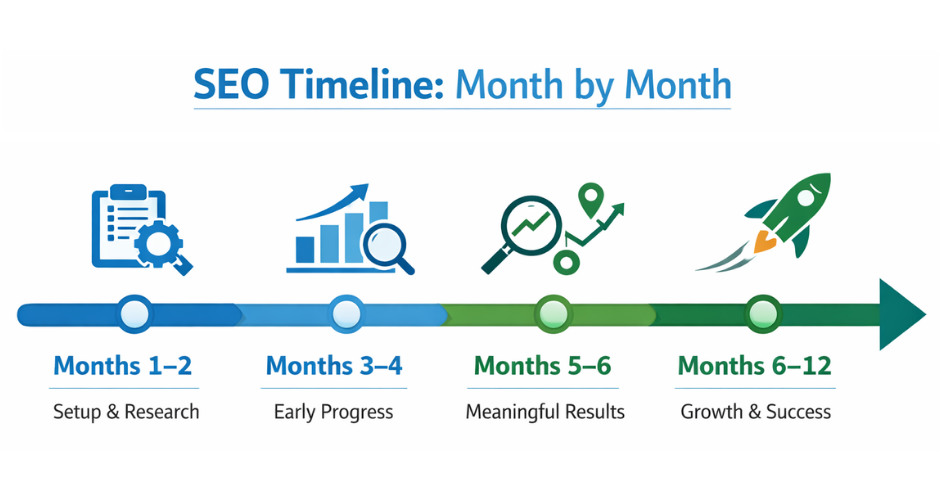
Early SEO work focuses on foundations. This includes fixing technical issues, improving site structure, researching what your customers actually search for, and making sure your pages clearly explain what you do and who you serve.
During this phase, rankings often do not change much. That is normal. Search engines are re-crawling your site, processing updates, and reassessing where your pages belong. Think of this stage as clearing the path so progress is possible later.
This is often when business owners start noticing encouraging signals. You may see:
These are early signs that things are moving in the right direction. They may not lead to immediate leads or calls yet, but they show that search engines are beginning to take your site seriously.
If you are wondering why your website still is not ranking higher at this point, there are usually clear reasons tied to competition, content depth, or how long similar sites have been established.
For many businesses, this is when SEO starts to feel real. Rankings become more stable, organic traffic grows more consistently, and people begin finding your business through searches that are not just your company name.
This is also when SEO insights become more useful. You can see which pages lead to contact form submissions, phone calls, or other real inquiries, which topics connect best with visitors, and where it makes sense to focus next.
Beyond six months, SEO becomes less about waiting and more about refining. Strong pages build credibility over time, newer content tends to rank faster, and your website benefits from the work already done.
This is where SEO often outperforms short-term tactics. The effort you put in months ago continues to pay off, often without increasing your ongoing costs.
SEO timelines are not fixed because several factors influence how quickly results appear.
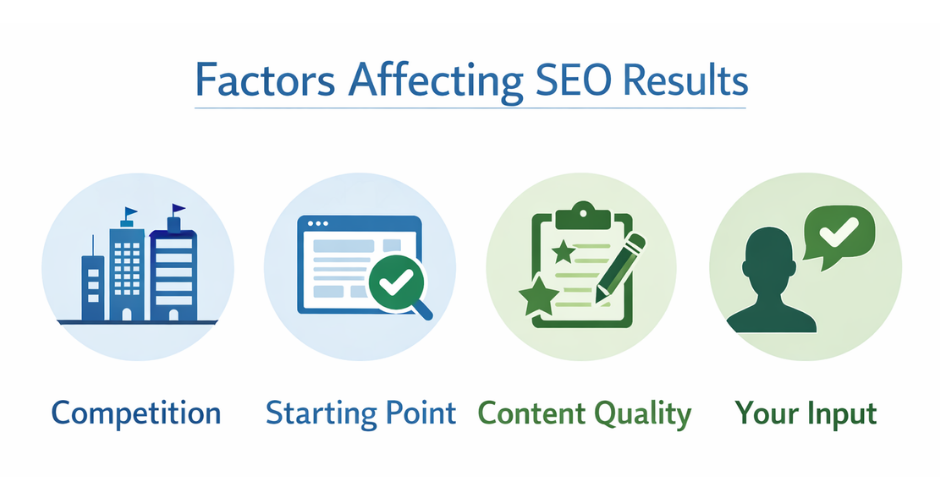
Competition matters. Ranking for a service in a small local market is very different from competing in a crowded national space.
Your starting point matters. A website that already has solid content and structure will move faster than one that has been untouched for years or just launched.
Content quality matters. Pages that clearly answer real customer questions tend to perform better than pages written just to fill space.
Your input matters. Search engines reward firsthand knowledge and credibility. That often requires details only you can provide, like how your process works, what makes your services different, and what customers commonly ask you before hiring.
One of the most common mistakes business owners make is judging SEO too early, or focusing only on rankings.
Before rankings fully improve, there are other signs to watch:
These signals show that both search engines and real people are responding positively to your website.
If you want a clearer way to evaluate progress without guessing, it helps to understand which metrics actually matter and which ones can be misleading.
It can be frustrating to see competitors outrank you, especially when their websites look outdated or thin.
In many cases, the difference comes down to time and consistency. A competitor may have been publishing helpful content for years, earning links naturally, or answering niche questions you have not addressed yet.
In other situations, competitors may be aligning better with how people search today, including newer formats and AI-influenced results.
Understanding why competitors rank higher is far more useful than trying to copy them page for page.
With AI-powered search results becoming more common, some business owners wonder if SEO timelines still apply. They do, but expectations need to be grounded.
Search engines increasingly reward clear, well-structured, trustworthy information that demonstrates real-world knowledge. That makes shortcuts even less effective and long-term thinking more important.
Optimizing for AI search is not about chasing trends. It is about clarity, credibility, and usefulness, the same qualities that have always driven sustainable SEO.
At Levitate, we help businesses approach SEO with clarity instead of guesswork. That means building websites and content designed to grow stronger over time, not quick fixes that fade once attention shifts elsewhere.
Our website platform supports SEO from the ground up, making it easier to publish helpful content, adapt as search evolves, and turn visibility into real business opportunities. Learn more about how our websites support long-term growth.
If you want to talk through your goals, your market, or where you currently are in the SEO process, we are always open to a practical conversation. You can book a brief demo anytime to see how we help businesses grow through clearer messaging and smarter SEO.
SEO takes time, but with the right expectations and the right partner, that time works in your favor.
We’ll give you a call to set up time for your team and ours to meet virtually for a personalized demo.
Book a Demo


.png)
%20(1).png)
.svg)
.svg)