We've recently updated our Terms of Service and Privacy Policy.

SEO has a reputation for being complicated, mysterious, and full of conflicting advice. If you’ve ever tried to make sense of it and walked away with even more questions, you’re not alone.
This guide breaks down answers to the questions we hear from business owners every day: a straightforward look at how SEO works, why certain strategies matter, and what truly helps a website grow steadily over time.
At its core, SEO helps Google understand your site and helps people find what they need.
Google’s goal is straightforward:
Show the best, most useful answer.
To do that, it looks at three broad categories of signals:
If any one of those areas is unclear or underdeveloped, it affects where you show up in search.
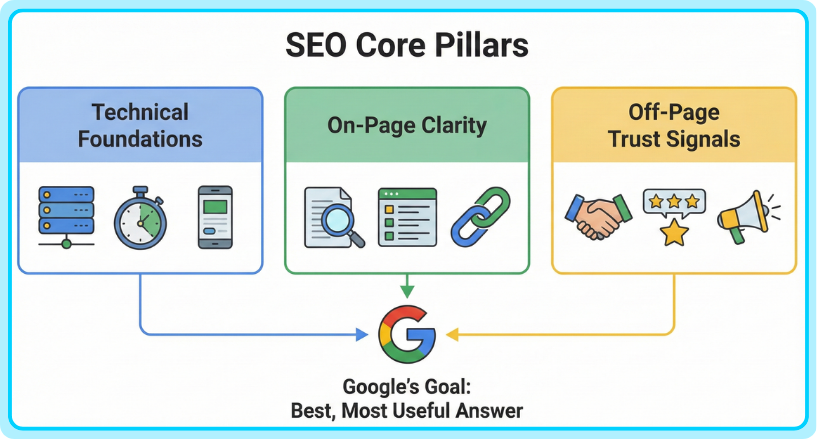
Google evaluates millions of pages every day. The specific algorithm changes constantly, but the larger principles stay consistent:
If you’ve ever wondered why a competitor outranks you despite having a weaker-looking website, the answer is usually hidden in one of these factors, especially trust and depth.
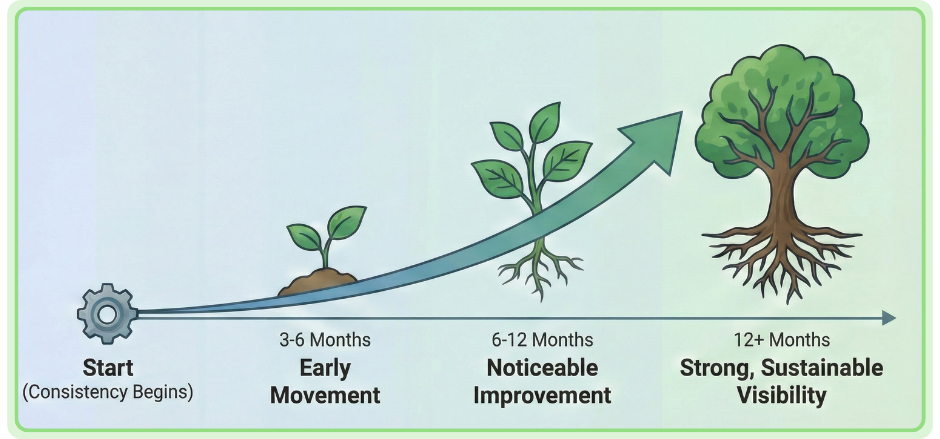
A common expectation is that SEO works like ads: you turn it on and results follow.
In reality, SEO behaves more like building momentum over time.
Here’s the simple timeline:
Google wants to see consistency and reliability before rewarding a site with higher rankings. That means new content, clearer structure, stronger trust signals, and improvements across your site need time to accumulate and be re-evaluated.
Competitive markets, outdated websites, or extremely thin content may take longer, but they’re fixable.
When businesses ask why they aren’t showing up, the answer is rarely one big issue. It’s usually a combination of smaller gaps that add up, such as:
A lot of websites struggle here because they simply don’t contain the depth or specificity Google uses to judge authority. Once you understand what Google is looking for, these issues become much easier to fix.
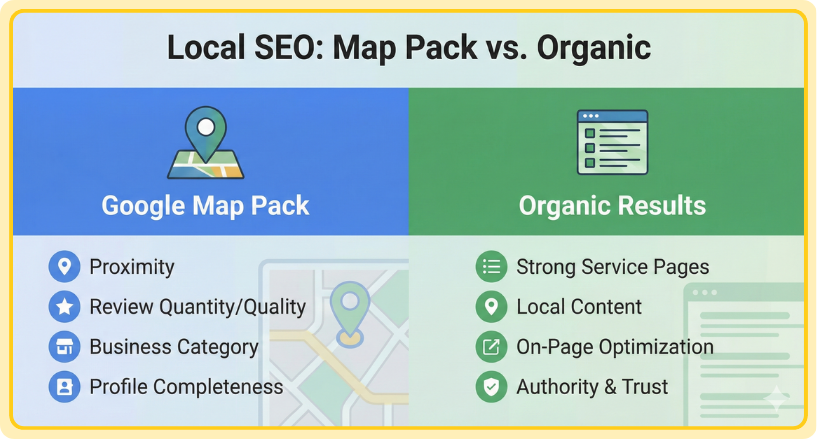
Local search brings an extra layer of complexity because Google uses two different systems depending on where your result appears.
These depend heavily on:
This explains why you might show up in the map results for one nearby neighborhood but not another.
These rely more on:
Because these systems work differently, a business can appear in one and not the other. Once you know that, the results make a lot more sense.
Local SEO often raises concerns about “sounding too specific.” Business owners understandably want their site to communicate broad reach, but Google still needs clear location signals. There’s an art to doing both, and most of it comes down to how you structure messaging rather than how many times a city name appears.
Content is one of the strongest tools you have, but not because of volume.
Content works when it:
A well-written article that explains a customer’s concern can outperform twenty generic blogs.
They work when they:
If your blogs read like something any business in the country could publish, Google will treat them that way.
Videos help when they introduce your team, explain a process, or clarify something visually better than text can. They build engagement and trust, two signals Google pays attention to.
You don’t lose rankings because you redesign a site. You lose rankings when the redesign removes content, changes URLs without redirects, or strips away context Google relied on. A thoughtful rebuild usually improves visibility, not harms it.
There’s a growing emphasis on real-world expertise. Google wants to know a business is legitimate and led by people who know what they’re talking about.
Agencies can write strong content, but they can’t invent:
When your site reflects the real business behind it, rankings improve because Google has something to trust.
When this information is missing, Google has to guess, and it rarely guesses in anyone’s favor.
AI Overviews and other emerging features haven’t changed the fundamentals, they’ve simply raised the bar. Google is looking for clarity, originality, and firsthand expertise.
The more your content demonstrates experience and practical knowledge, the easier it is for AI to understand and surface it.
This shift rewards websites that communicate clearly and punishes those built on shortcuts, keyword tricks, or generic writing.

SEO can:
SEO cannot:
Think of SEO as long-term visibility infrastructure. Once it’s built well, it keeps paying off.
If you’re ready for a website built around clear messaging, strong SEO structure, and trustworthy content, Levitate can help.
Learn more about custom websites with Levitate or book a brief demo to see how we help businesses grow through smarter websites and SEO.
We’ll give you a call to set up time for your team and ours to meet virtually for a personalized demo.
Book a Demo


.png)
%20(1).png)
.svg)
.svg)