We've recently updated our Terms of Service and Privacy Policy.

One of the most common questions business owners ask is:
“Why do we show up on Google Maps, but not in the regular search results?”
—or the reverse—
“Why does our website rank, but we’re nowhere in the map listings?”
It’s a fair question because Google often displays multiple types of results on the same page, and they don’t all work the same way.
If you’ve searched for your own business and noticed inconsistent visibility depending on the city, search phrase, or device, you’re not imagining things. Google’s local map results and traditional organic rankings operate on different systems with different priorities.
Understanding the difference helps set better expectations and gives you a clearer picture of what your SEO strategy actually needs.
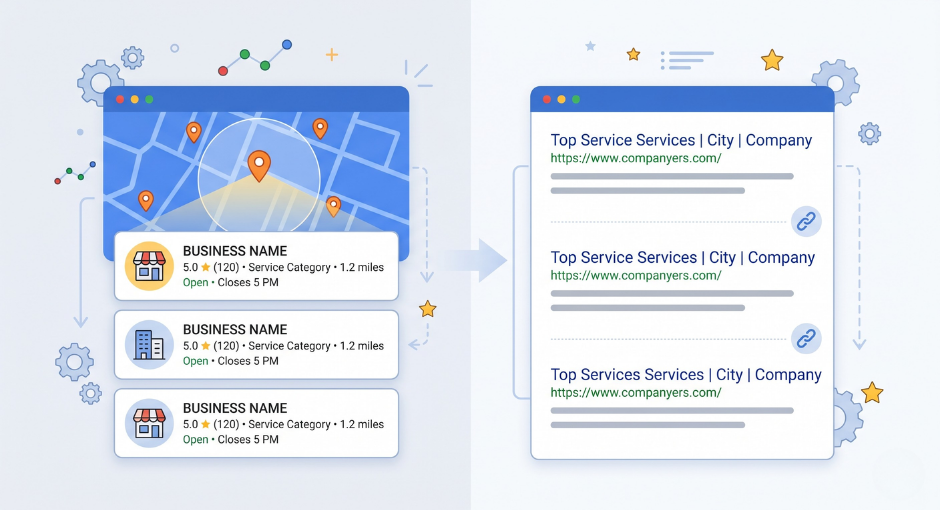
When someone searches for a local service, Google may show:
These sections look connected, but they’re evaluated differently.
That means your business can perform well in one area and struggle in another without anything being “wrong.”
For example:
This is one reason local SEO can feel confusing from the outside.
The Map Pack is heavily tied to Google Business Profile signals and local proximity.
In simple terms, Google is trying to answer:
“Which businesses are nearby, relevant, and trusted for this search?”
That means Map Pack rankings are influenced by things like:
Distance matters here more than many business owners realize.
If someone searches “plumber near me” from downtown Richmond, Google is more likely to show businesses physically closer to downtown—even if another company has a stronger website overall.
This is why rankings can change dramatically from one neighborhood to another.
It’s also why businesses sometimes feel confused when they “rank first” from their office computer but not from another part of town.
Organic results are more focused on your website itself.
Google looks at factors like:
Organic SEO tends to reward businesses that build useful, location-aware content over time.
Unlike the Map Pack, organic rankings can often reach beyond the immediate area surrounding your office.
For example, a financial advisor in one suburb may rank organically throughout an entire region if their website clearly explains their services, service areas, and expertise.
This is where many businesses start learning the difference between “being visible nearby” and “building broader search visibility.”
This is another common source of frustration.
A business owner searches from their city and sees great rankings. Then a customer in a neighboring town says they can’t find the business anywhere.
That’s normal in local SEO.
Google personalizes local search results based on geography. Even small distance changes can affect the Map Pack significantly.
Organic results can vary too, especially when Google believes certain pages are more relevant to specific cities or regions.
This is why businesses can’t realistically expect to dominate every surrounding city simply because they serve those areas.
Google wants confidence that your business is genuinely relevant to the location being searched.
That relevance usually comes from a combination of:
A lot of businesses hear some version of:
“Just add more city names to your website.”
Unfortunately, it’s not that simple anymore.
Google has become much better at understanding whether content is genuinely useful or simply trying to rank everywhere.
Mentioning a city occasionally can help clarify service areas, but effective local SEO is really about relevance and trust.
For example, compare these two approaches:
Weak approach:
“We serve Richmond, Midlothian, Glen Allen, Chesterfield, Mechanicsville…”
Stronger approach:
A page that explains:
The second approach gives Google—and potential customers—more confidence that your business truly serves that area.

One thing Map Pack and organic rankings do have in common is trust.
Google wants to recommend businesses that appear legitimate, reliable, and experienced.
That trust can come from:
This is part of what Google refers to as experience, expertise, authority, and trustworthiness.
Even though business owners rarely use those terms day-to-day, the idea is straightforward: Google wants confidence that your business is credible and helpful.
One of the healthiest mindset shifts in local SEO is realizing that visibility is not all-or-nothing.
Strong local search performance usually comes from layering multiple signals over time:
That combination helps businesses become more visible in the places that matter most.
Instead of chasing every ranking fluctuation, it’s often more productive to focus on building long-term local relevance and trust.
At Levitate, we spend a lot of time helping businesses understand why they appear in certain search results and what practical steps improve visibility over time.
Our approach combines website strategy, local SEO structure, content development, and real-world service-area optimization so businesses can build stronger visibility without relying on shortcuts or guesswork.
Learn more about how our website platform supports local growth.
And if you’d like to talk through your current visibility challenges, you’re always welcome to book a conversation with our team.
We’ll give you a call to set up time for your team and ours to meet virtually for a personalized demo.
Book a Demo


.png)
%20(1).png)
.svg)
.svg)