We've recently updated our Terms of Service and Privacy Policy.

If you’ve invested time or money into SEO, it’s a fair question: is this actually doing anything?
Unlike paid ads, where results can show up almost immediately, SEO tends to feel slower and less obvious. That uncertainty can make it hard to know whether things are on track or if something needs to change.
The good news is, there are clear ways to measure progress. You just need to focus on the right signals.
Let’s break down what actually matters, what to ignore, and how to tell if your SEO is moving in the right direction.
Before diving into metrics, it helps to understand what “working” looks like over time.
SEO isn’t a switch you flip. It’s more like building momentum. Early on, you may not see a spike in leads or calls, but that doesn’t mean nothing is happening behind the scenes.
Search engines are evaluating your site, indexing new content, and gradually increasing your visibility.
If you’re expecting immediate results, it’s easy to assume SEO isn’t working when, in reality, it’s just early.
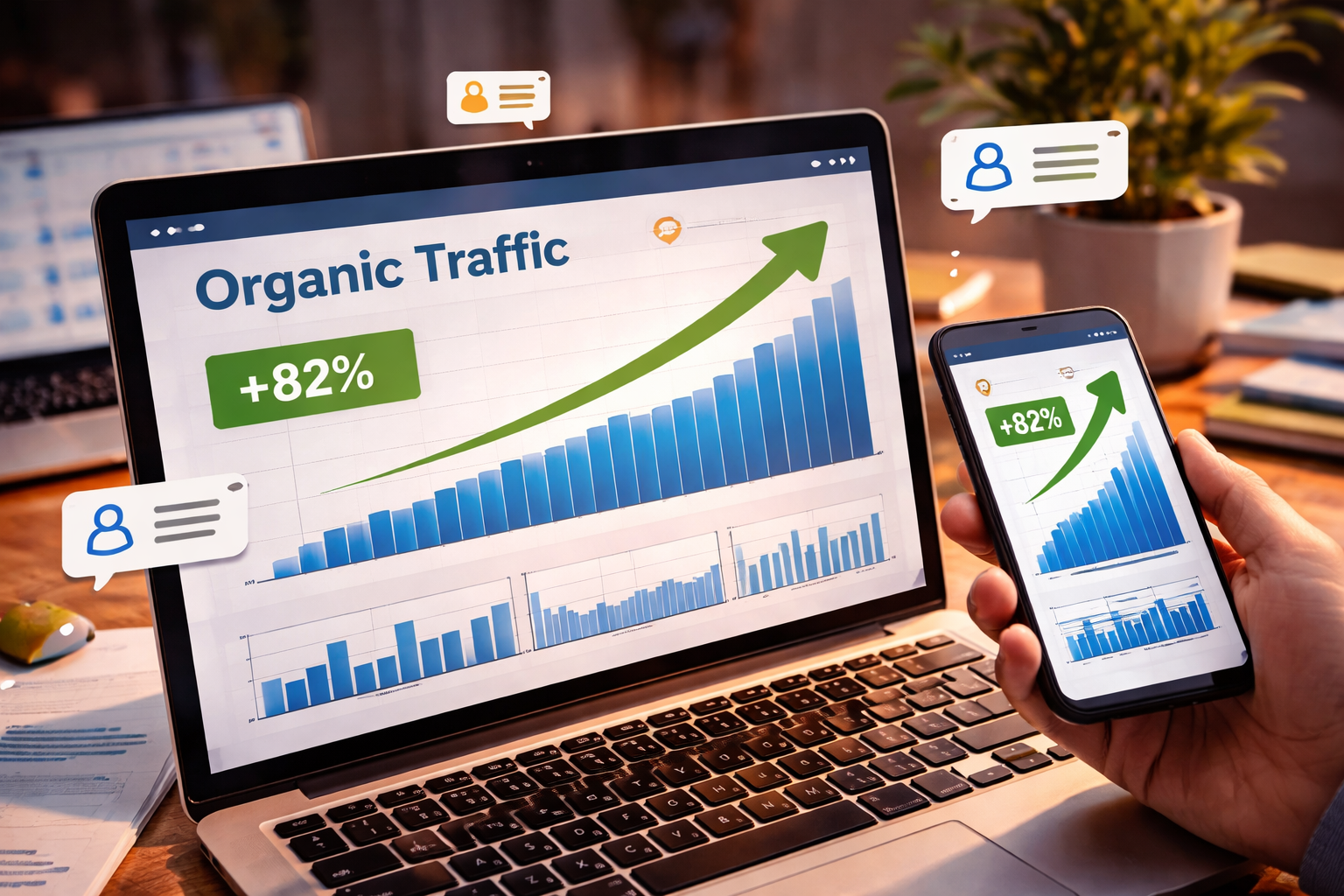
One of the clearest signs SEO is working is an increase in organic traffic—people finding your site through search engines like Google.
This doesn’t have to be dramatic. In fact, steady growth is usually a better sign than sudden spikes.
For example:
What matters is direction, not perfection.
Also, pay attention to which pages are gaining traffic. If blog posts or service pages are starting to get visits, that’s a strong signal your content is being discovered.
Keyword rankings track where your website appears in search results for specific terms.
If you’re moving from page 5 to page 2, that’s meaningful progress, even if you’re not on page 1 yet.
A few important points:
For example, if you’re a financial advisor, ranking for “retirement planning in Richmond VA” is far more valuable than a broad term like “finance tips.”
If your rankings are improving for relevant, local, or service-based searches, SEO is working. And if you’re wondering why your site still isn’t showing up where you expect, it’s worth understanding the common reasons behind that.
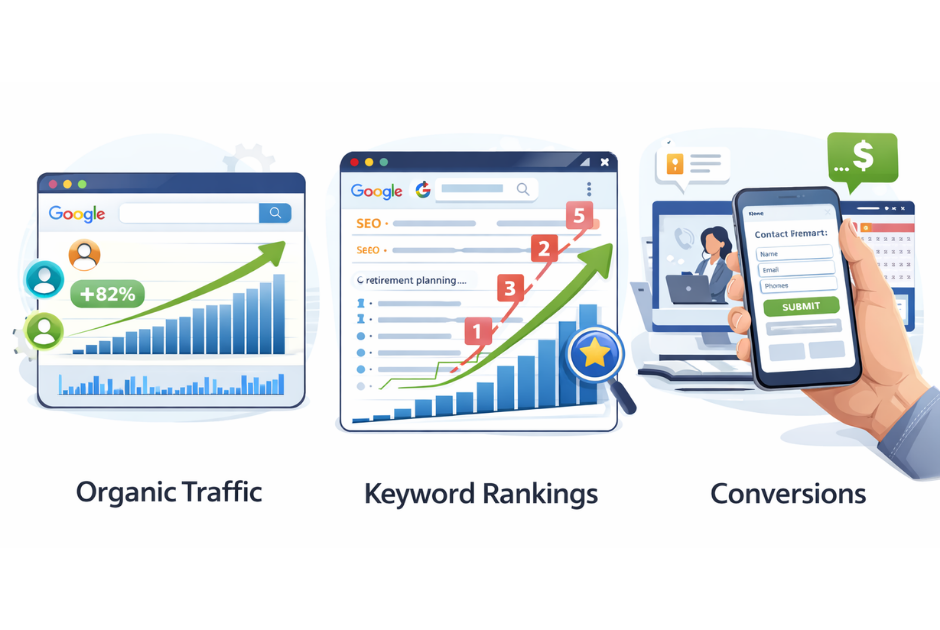
Traffic is helpful, but it’s not the end goal.
What really matters is whether visitors are taking action:
This is where SEO connects directly to revenue.
Even a small increase in conversions can be significant. For example:
If traffic is growing but conversions aren’t, that’s not necessarily an SEO issue; it may be a messaging, design, or user experience problem.
Click-through rate (CTR) measures how often people click your site when it appears in search results.
If your page is showing up but not getting clicks, it usually points to:
For example, if someone searches “estate planning attorney near me” and your listing sounds vague or generic, they may skip over it, even if you’re ranked well.
Improving CTR often comes down to clarity and relevance.
Once people land on your site, what do they do?
Engagement metrics help answer that:
If visitors are sticking around, reading content, and exploring your site, that’s a strong signal your content is useful and aligned with what they were searching for.
If they leave quickly, it may mean:
This is where SEO and website experience overlap.
It’s easy to get distracted by metrics that sound important but don’t tell the full story.
A few to be cautious with:
The goal isn’t to chase numbers. It’s to understand whether your visibility and business outcomes are improving.
Another common source of confusion is how SEO compares to paid channels like Google Ads.
SEO builds long-term visibility. Ads provide immediate placement.
Both have their place, but they behave very differently.
If you’re expecting SEO to deliver instant leads like ads, it can feel underwhelming. But over time, SEO often becomes the more cost-effective and sustainable source of traffic.

Content plays a central role in SEO. It’s how search engines understand what your site is about and when to show it.
Recently, AI-generated content has added a new layer of complexity. While it can help with efficiency, it still needs to be guided by real expertise and intent.
Search engines prioritize content that reflects real experience and usefulness, not just volume.
At its core, SEO isn’t just about rankings, it’s about trust.
Search engines are trying to determine:
That’s why factors like expertise, experience, and reputation matter more than ever.
Here’s a simple way to think about it:
If over time you’re seeing:
Then your SEO is working, even if it doesn’t feel dramatic day-to-day.
If those things aren’t happening, it’s worth digging deeper into what’s missing:
SEO can feel unclear because the results aren’t always immediate or obvious, but the right metrics make it much easier to evaluate.
At Levitate, we focus on helping businesses connect the dots between visibility, content, and real outcomes. That includes building websites that are structured for search, creating content that answers real questions, and tracking the metrics that actually matter.
If you’re looking to better understand how your website is performing, or want a clearer path forward, you can explore how we approach website strategy.
And if you’d rather talk it through, you’re always welcome to reach out and book a demo with a Levitate product expert.
We’ll give you a call to set up time for your team and ours to meet virtually for a personalized demo.
Book a Demo


.png)
%20(1).png)
.svg)
.svg)