We've recently updated our Terms of Service and Privacy Policy.

In 2026, sending emails is easy. Getting them seen is the real challenge.
Spam filters are more advanced than ever, and businesses that rely on mass email blasts are seeing lower open rates and reduced engagement. If your emails are not reaching the inbox, they are not driving results.
For service-based businesses, success comes down to one thing: sending emails that feel personal, relevant, and trustworthy.

Spam filters are designed to protect users from unwanted or harmful messages. But they do not just block obvious scams. They also filter out emails that feel impersonal or low-value.
Common triggers include:
Mass email platforms that send one message to hundreds or thousands of recipients at once are especially vulnerable. Even if the content is legitimate, the sending behavior can raise red flags.
Traditional email marketing tools often rely on bulk sending. One email is sent to a large list, sometimes using BCC or external servers.
This creates two problems:
As inboxes become more crowded, people are quicker to delete or ignore emails that feel automated.
The result is lower open rates, lower engagement, and missed opportunities.
Spam filters prioritize emails that look and behave like real, one-to-one communication.
That means emails sent:
These signals tell email providers that your message is legitimate and worth delivering to the inbox.
Just as important, they make recipients more likely to open and respond.
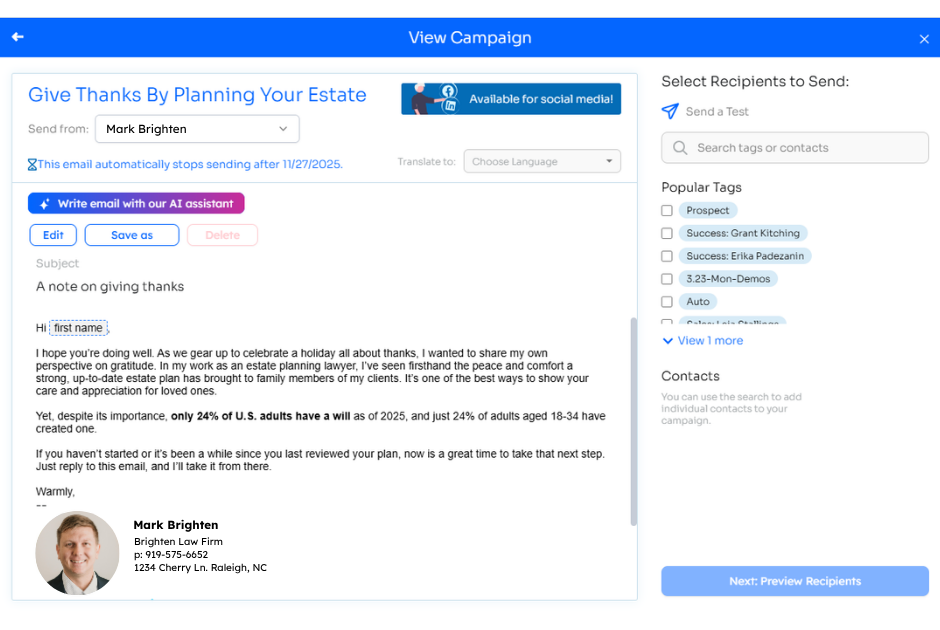
Levitate is designed differently from traditional email marketing platforms.
Instead of sending bulk emails through external systems, Levitate integrates directly with Gmail and Outlook. Emails are sent individually from your own inbox, just like a normal one-to-one message.
This approach:
You are not blasting a list. You are building relationships at scale.
Even with the right tools, how you send emails still matters.
To improve results:
Consistency and authenticity go further than volume.
Beyond deliverability, it is important to follow email best practices and regulations like the CAN-SPAM Act.
This includes:
Compliance is not just about avoiding penalties. It also reinforces trust with your audience.
In 2026, email success is not about sending more. It is about sending smarter.
When your emails feel personal, relevant, and timely, they are far more likely to reach the inbox and get opened.
Levitate helps service-based businesses do exactly that by combining the scale of marketing with the authenticity of one-to-one communication.
Book a demo to see how it can improve your deliverability and help you build stronger relationships through email.
We’ll give you a call to set up time for your team and ours to meet virtually for a personalized demo.
Book a Demo


.png)
%20(1).png)
.svg)
.svg)


.png)
